


In my opinion, many “canonizations” and “beatifications” of the recent decades since the Second Vatican Council have been accompanied by hypocrisy.
The Martyrs of China, Vietnam and Korea
“John Paul II” is known for “canonizing” more people than any pope before him. These include the 120 Martyrs of China (18 beatified by Leo XIII, 14 by Pius X, 86 by Pius XII, 2 by “John Paul II”), the 117 Martyrs of Vietnam (64 beatified by Leo XIII, 28 by Pius X, 25 by Pius XII) and the 103 Martyrs of Korea (79 beatified by Pius XI, 24 by “Paul VI”). Bergoglio “beatified” an additional 124 martyrs of Korea.
Most of them were simple lay people, some were religious, some were priests, and some were missionary priests. All of them were martyred in predominantly Buddhist countries.
“Francis” claimed in Singapore in 2024 that “All religions are paths to God. I will use an analogy, they are like different languages that express the divine. […] There is only one God, and religions are like languages, paths to reach God.”
If Buddhism is another way to arrive at God, why did these martyrs die?
“I entered the Church with nothing else in mind than to serve God and save my soul.” (Blessed Kim Teresia in a letter to her family, 1797-1840) (here)
“Is there no other way of practicing virtue and doing good besides entering the Catholic
Church?”
“No, there is no other way.”
“Don’t you think Confucius and Mencius are sages then?”
“They are sages but only of this world.” (Blessed Kim Hyo-im Columba interrogated by a chief judge, 1814-1839) (here)

The “103 Martyrs of Korea” on a painting in the Buenos Aires Cathedral. Image by Lawrence Lew OP, CC-BY-NC-ND 2.0, here.
The Martyrs of Uganda
In a previous article, I have already talked about the Martyrs of Uganda, highlighting the fact that there was a group photo of them less then a year before their deaths, during a visit of a French missionary bishop.
The Martyrs of Uganda were a group of 22 Catholic and 23 Anglican men, mostly young men, who were killed by order of king Mwanga in the country of Buganda.
Blessed Charles Lwanga (1861?–1886) was a courtier of the king and the leader of the group. He also worked as catechist.
What is often left out of descriptions of their lives is that the king was a homosexual and a pedophile. He got enraged that his courtiers, who converted to the faith, encouraged those courtiers whom the king wanted to exploit homosexually, to resist his advances.
They were beatified by Pope Benedict XV in 1920 and “canonized” by “Paul VI” in 1964.
The English martyrs
After King Henry VIII broke with the Catholic Church in the 16th century over his divorce and made himself “Head of the Church of England”, he started persecuting Catholics. About 600 Catholics were martyred during the Reformation in England.
Besides St. John Fisher and St. Thomas More, Leo XIII beatified 61 martyrs, Pius XI beatified 136 martyrs and John Ogilvie SJ of Scotland. “Paul VI” “canonized” Ogilvie as well as 40 of the martyrs beatified before. “John Paul II” “beatified” the “85 Martyrs of England, Scotland and Wales” in 1987.
Under Queen Elizabeth I, being a Catholic priest was declared treason, the punishment for which was hanging, drawing and quartering. Sheltering priests was illegal as well. Everyone had to participate in Anglican church services on Sundays, and everyone who didn’t go, had to pay a fine.
However, Catholics couldn’t participate, since active participation in non-Catholic rites is always forbidden and passive participation is only permitted when there is some grave reason, for example taking part in a wedding or a funeral. This principle was clearly understood in earlier times. For example, the canonist Naz wrote in his commentary on the 1917 Code of Canon Law: “It is not permitted to pray, to sing, or to play the organ in a heretical or schismatic temple by associating with the faithful who celebrate their worship, even if the terms of the chant and the prayers are orthodox.” (quoted by Archbishop Lefebvre here)
Blessed John Rigby (1570?-1600), a servant from Lancashire, was indicted because he stopped going to Anglican services. The judge offered to let him go on the condition that he only visits those services a few times a year, but he refused. He was hanged, drawn and quartered.
Blessed Philip Howard, Earl of Arundel (1557-1595), was a nobleman who was falsely charged with praying for the success of the Spanish armada. He was charged with treason and sentenced to death, but Queen Elizabeth never signed the order to execute him. He became ill in prison and asked to see his family for the last time. The queen answered that he would be set free immediately if he would participate in just one Anglican service, but he refused. He died shortly after.
Meanwhile, the Anglican church maintained a lot of superficial similarities with the Catholic Church, especially in their Church services, their architecture and other external things. Although they kept ordaining bishops and priests, the ordination rite was so changed under King Edward VI that it became invalid. In 1896, Pope Leo XIII issued the document “Apostolicae curae”, in which he definitively ruled: “we pronounce and declare that ordinations carried out according to the Anglican rite have been, and are, absolutely null and utterly void.”
And what did “John Paul II” do? During his visit to England in 1982, he met the “Archbishop of Canterbury”, Robert Runcie, called him “Archbishop of Canterbury”, and allowed him to be called the “successor of Saint Augustine [of Canterbury]”. Later in his reign, he gave Anglican “bishops” pectoral crosses as gifts.
So instead of denouncing these so-called “Archbishops of Canterbury”, the last few “popes” reinforced the idea that these are indeed bishops.
“I will not pray with you, and you shall not pray with me; neither will I say Amen to your prayers, nor shall you to mine.” Blessed Margaret Clitherow to Protestant ministers, who tried to get her to pray with them (source, quoted here)

The “40 Martyrs of England and Wales” on a lithography by Daphne Pollen.
The French martyrs
After the French Revolution, during the reign of terror of the Jacobins, Catholic priests were required to take an oath on the French constitution. The Pope forbade the oath.
Around 56% of priests and 4 of 125 bishops disobeyed the Pope and took the oath. Priests who refused the oath, known as non-juring priests, were heavily persecuted and many of them killed. Some were shot, others guillotined, and the martyrs of Rochefort were left to die on a ship.
16 martyrs were beatified by St. Pius X, 15 by Benedict XV, 223 by Pius XI, and 19 by Pius XII. “John Paul II” “beatified” the “99 Martyrs of Anjou” and 64 of the martyrs of Rochefort.
As Catholic journalist Louie Verrecchio pointed out, the Second Vatican Council document “Dignitatis humanae” implicitly submits the Church to state power in the name of “just public order”.
“This right of the human person to religious freedom is to be recognized in the constitutional law whereby society is governed and thus it is to become a civil right … Therefore, the right to religious freedom has its foundation not in the subjective disposition of the person, but in his very nature. In consequence, the right to this immunity continues to exist even in those who do not live up to their obligation of seeking the truth and adhering to it and the exercise of this right is not to be impeded, provided that just public order be observed.” (Dignitatis humanae 2)
By contrast, Leo XIII declared in “Immortale Dei” that “[t]o wish the Church to be subject to the civil power in the exercise of her duty is a great folly and a sheer injustice.”
Pope Pius XI stated in “Quas Primas” that “the Church, founded by Christ as a perfect society, has a natural and inalienable right to perfect freedom and immunity from the power of the state”.
During the c-virus, the results of this new idea were seen as the “hierarchy” ordered or silently expected that priests obey the government and shut down their churches.
The Spanish martyrs
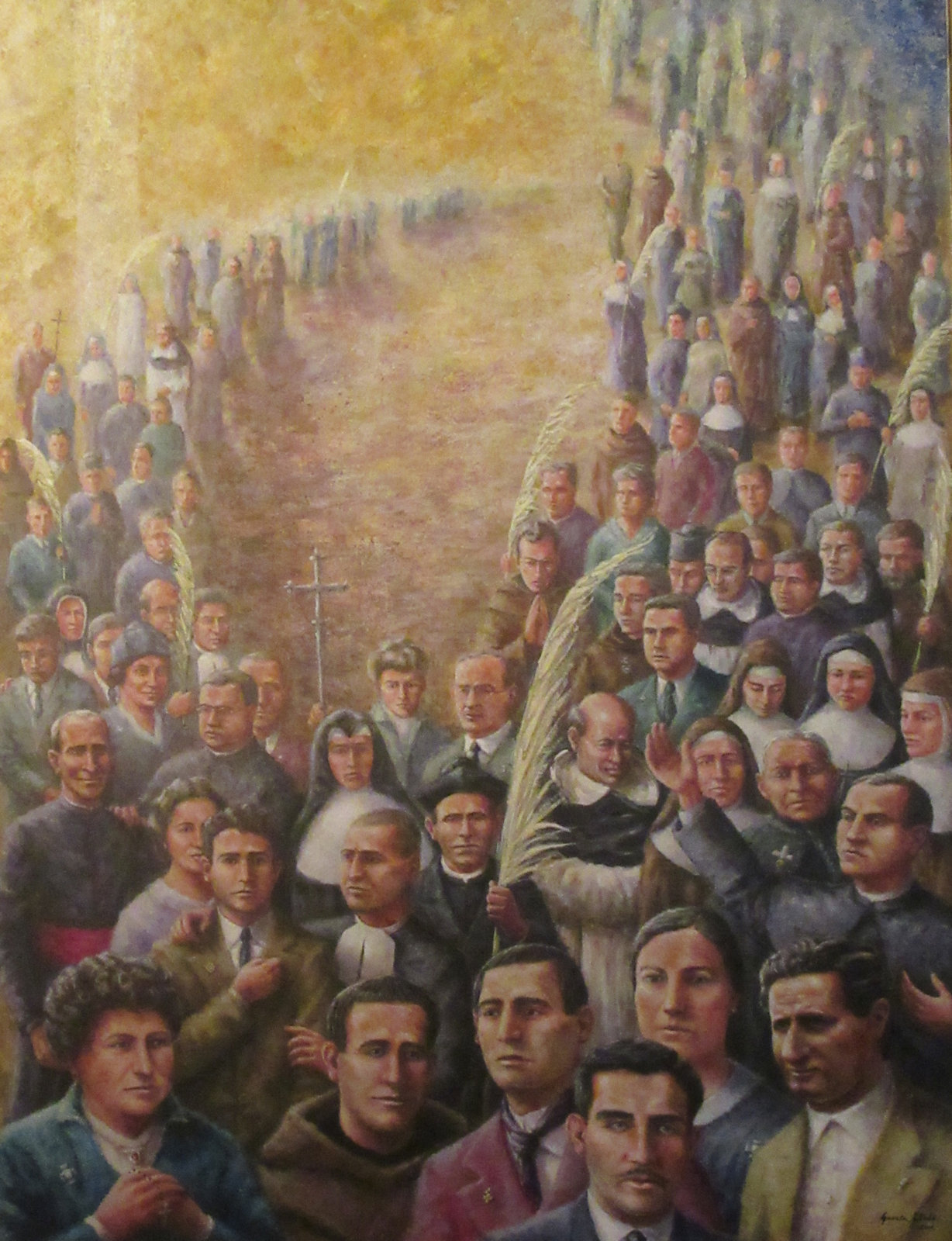
Two years ago, I have written two articles on this site on laymen and laywomen, who were martyred during the Spanish Civil War (1936-1939). During that conflict, especially in the first six months, 13 bishops, at least 9000 priests, seminarians, monks and nuns, and at least 3000 laypeople were martyred by communists or other leftist militias allied with the Republic.
471 martrys were “beatified” by “John Paul II”, 530 by “Benedict XVI” and 1129 by Bergoglio. This would make up a considerable proportion of all the saints and blessed of the Church.
When I was researching the Spanish martyrs two years ago, when I was writing my articles on the martyred laymen and laywomen, I was struck by how many sources gave vague accounts of the deaths of these martyrs. Usually, when we talk about martyred saints, their deaths are the most emphasized part of their lives.
This is not very surprising, since the Catholic Church was continuously attacked for supporting Franco in the civil war.
One of the few sources who give an honest account of these martyrs and name the affiliations of the perpetrators is Juan Cruz (pseudonym) from the portal “El Español Digital”, which I have used extensively as a source.

Painting of some of the martyrs of Valencia in the Cathedral of Valencia. Image from the Ökumenisches Heiligenlexikon, CC-BY-NC-SA, here.
Conclusion
To summarize, the “popes” of the last decades after Vatican II have “beatified” and “canonized” hundreds of people in groups of martyrs.
These martyrs died because:
–they proclaimed the social kingship of Christ,
–they held firm to their faith in the face of Buddhism
–stood up to a homosexual king
–refused to participate in Protestant church services
–obeyed the Pope and did not swear to a constitution which was at odds with Christian values
–defended the freedom of the Church.
Why don’t some church officials share the values of these people if they consider them saints?